Art Photography · Fine Art Photography
'Expressions of the Wild' - A Photo Alchemy Experience
How a giraffe, seen for a moment in the bushveld at Marloth Park, became an artwork. Camera movement, handmade texture, and the Photo Alchemy process.
There are moments in photography that cannot be planned, and sometimes not even prepared for. They arrive unexpectedly, quietly, and often without announcement. One moment you are simply observing, and the next, something begins to unfold in front of you that asks to be felt before it can be photographed.
This artwork began in such a moment.
During the Marloth Park Wildlife Art Photography Workshop, we set out to explore creative ways not only to photograph wildlife in its natural environment but also to bring our photography into a more unusual and expressive creative space. The purpose of the workshop was not simply to record what we saw, but to look more deeply, to slow down, to observe more carefully, and to photograph with a clear artistic intent.
This is where PhotoAlchemy becomes such an important part of the process.
PhotoAlchemy allows us to take the photographic experience of the bushveld and move beyond straightforward photography. It gives us permission to work with texture, colour, distortion, composition, movement, and artistic expression. We begin to ask different questions. How can all these elements be transformed into something far more expressive?
One afternoon, around lunchtime, I took a walk to see what I could find in the surroundings near where we were presenting the class. Not far from where we were working, I spotted a group of giraffes moving quietly through the bushveld.
I came back and called Samantha, my daughter, to join me so she could experience it as well. There is always something special about sharing these moments, especially when they are not staged or planned. The giraffes were simply there, moving naturally through their own environment, and we had the privilege of observing them.
Later that afternoon, I decided to go back and have another look. I thought by then the giraffes would probably have moved on, and that I would not find them again. But when I returned, the light had changed beautifully, and to my surprise, they were still in and around the same area where I had first found them.
Earlier, when the light was not quite right, standing and observing had been enough. That memory was special in itself, and I knew it would stay with me. But now, the light was incredible. The angles were right. The only problem was that the thicket was quite heavy, and the giraffes were mostly behind the trees' cover. From a photographic point of view, there was still very little I could do. I could see them and experience the moment, but there was no clear photograph. The bushveld was dense, the animals were partially hidden, and the scene did not readily present itself.
But then that moment happened.
At one point, the giraffes must have been startled by something, and they began to move unexpectedly through the surrounding landscape. As they shifted through the trees, one giraffe stepped out from behind the thicket and gently galloped across a more open part of the bushveld.
There was majesty in that movement. The sound of its hooves carried through the bush with a deep, solid thudding rhythm, gentle yet powerful, as it crossed the open ground. It was not dramatic in the obvious sense. There was no grand performance, no rush, no spectacle. Yet there was something deeply expressive in the way the giraffe moved through that space — a quiet rhythm, a natural elegance, and a presence that seemed perfectly at home in the landscape.
That was the moment I had been waiting for.
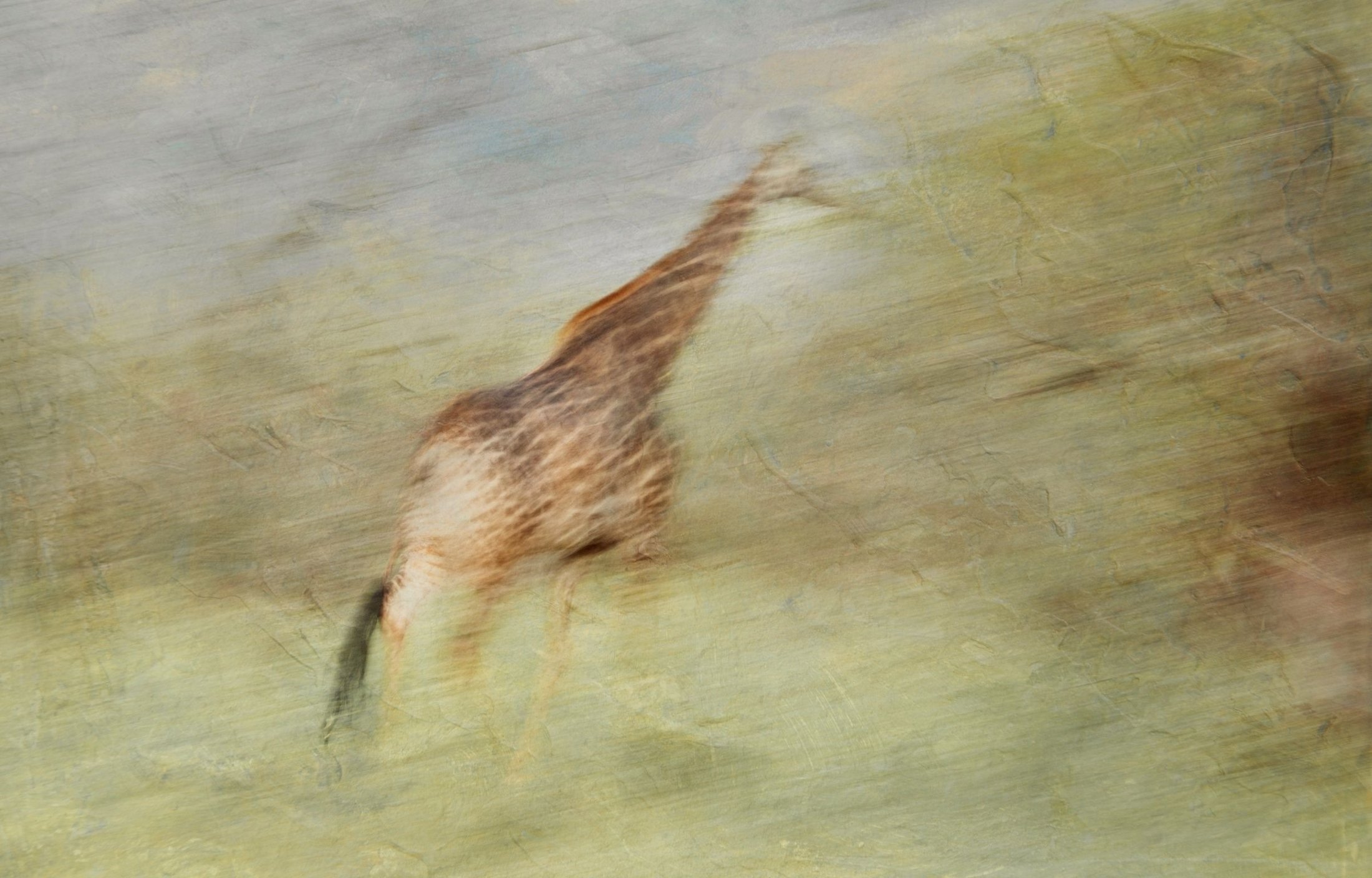
As the giraffe crossed the open section of the bushveld, I photographed it using intentional camera movement. The aim was not to record the giraffe literally. Photography is, of course, a reality-based medium, and that is one of its great attractions. But in this case, I wanted to respond to how the moment felt. Sometimes in photography, it is more about feeling than recording.
Watch the video below to get an idea of what I experienced.

For me, this is where photography becomes more than documentation.
The camera records what is in front of us, but the artist must decide what the moment means. This is where the creative process begins. Instead of trying to make a sharp, literal wildlife photograph, I wanted to respond to the scene's atmosphere. I wanted to convey the giraffe's feeling of moving through the wild, rather than simply describe its physical appearance.
This is the heart of PhotoAlchemy.
PhotoAlchemy is the process of taking a photographic moment and allowing it to become something more expressive, more interpretive, and more personal. It begins with the camera, but it does not end there. The photograph becomes a starting point — a foundation on which layers of feeling, texture, movement, and artistic decision-making can be built.
In this piece, the giraffe became part of a broader visual expression. The surrounding bushveld, the textures of the trees, the movement of the animal, and the emotional memory of being there all began to work together. The final artwork is not intended to be a straightforward wildlife photograph. It is an interpretation of an encounter.
There is something very special about photographing wildlife in this way. When working in the bush, one is constantly reminded that nature does not perform on demand. The artist has to be patient, sensitive, and open to what is happening. Sometimes the most meaningful moments are not the loudest ones. They are the quiet gestures — a turn of the head, a shift in posture, a movement through light, or the relationship between an animal and its environment.
The giraffe, with its graceful form and gentle presence, lends itself beautifully to this kind of creative interpretation. Its long lines, patterned markings, unusual linear shape, and elegant movement offer so much more than a subject to photograph. It becomes a visual language. It speaks of stillness, balance, curiosity, and quiet strength.
During the workshop, one of the ideas we explored was how to move beyond taking pictures of wildlife and begin creating artwork from the experience of being in the wild. This shift is important. It asks us to become more observant of the animal's shape and the surrounding textures. It also encourages us to bring all of this into a creative space where the artwork is not always created in an instant but is steadily built up through various techniques applied in the workshop environment or afterwards in the studio.
The bushveld is full of these opportunities, and I think this is where wildlife photography certainly comes into its own: when the landscape of the wildlife is respected, and the animal becomes part of that composition, completing the story.
Unusual lighting, dust, wind, angles of light, and movement can all contribute towards the final expression. When we allow ourselves to think in this way, photography becomes part of a much larger conversation. It is not only about what was seen, but also about what can be taken further, interpreted, and transformed.
The artwork then becomes part of this conversation.
The photograph on its own was strong enough to be used, but I felt it needed something more. The intentional camera movement had given me the linear lines and the giraffe's shape, but something was still missing. That very something was texture.
I decided to introduce textures that I had created by hand onto the piece — light textures that would gently pull everything together without overwhelming the image. I created two textures by hand with paint and texture paste, and once they were incorporated into the artwork, I knew this was exactly what the piece needed.
This artwork of the giraffe, an expression from the wild, was created here.
It is a reminder that the wild is not only something we look at. It is something we experience. It moves around us, but it also moves within us. When we slow down enough to notice this, the camera becomes more than a tool for capturing what we see. It becomes a way of translating what we feel.
This is what excites me most about the art of photography.
It allows a fleeting moment to become a lasting expression. It gives space for the subject, the environment, and the artist’s response to come together. In this case, the giraffe was not simply photographed. It became part of an artistic experience — one shaped by the beauty of Marloth Park, the atmosphere of the bushveld, and the creative process of PhotoAlchemy.
I am very happy to have this piece showcased in our gallery. Not only is it an artwork, but it also brings back memories of a special day. This is something I have spoken about in a YouTube discussion on memories within photography — how a photograph can carry more than an image, and how it can hold a moment in one’s life that might otherwise pass quietly into the past.
Every time I look at this piece, I will remember that afternoon: the light, the stillness, the sound of the hooves, the unexpected movement, and the privilege of being there when the moment unfolded.
And perhaps that is where the real magic lies.
Not in trying to control the wild, but in allowing it to speak.
The newsletter
Get the next article by email
New articles, classes and workshops, sent now and then. Nothing else.
Thank you. Please check your inbox and click the link in the confirmation email to finish signing up.
We send one email to confirm your address. You can leave with one click at any time.
Keep reading
More articles
Sharpness Has a Voice, and So Does Blur
Why chasing sharpness might be costing you creative depth in photography. A look at when to hold focus and when to let blur do the talking instead.
Breaking Free from the Lonely Art of Art
Making work alone is not the same as making it in isolation. Why creative partnerships matter, and how to find people who actually see what you are doing.
The Art of Digital Hand-Painting in Photoshop
Samantha Lee Osner takes a black-and-white photograph and paints it by hand in Photoshop. No painting experience is needed to follow what she does.